In short
- LED neon gives a continuous line of light; a bare LED strip often shows separate dots of light.
- LED neon is bent into the shape of letters or a logo; an LED strip is meant for straight lines and indirect lighting.
- A NeonFlowz LED neon sign comes complete: tube on a backing, power adapter, dimmer with remote control and mounting kit.
- You usually buy an LED strip on a roll and cut and stick it yourself.
- You can combine them: an LED strip for the room, an LED sign as the eye-catcher.
The difference at a glance
| LED neon sign | LED strip | |
|---|---|---|
| How the light looks | A continuous, even line | Often separate dots of light, unless it is concealed |
| What it is for | A logo, name or text that lights up itself | Indirect lighting: under a cabinet, behind a TV, along a ceiling |
| Shape | Bent into the shape of your design | Straight or in long lines |
| What you get | A complete sign on a backing, with power adapter, dimmer and mounting kit | Usually a roll you cut to size and stick on yourself |
| Hanging | With stand-offs or on hanging wires, in about ten minutes | Stuck on or in a profile, along the line you want to light |
| Who makes it | Made to measure, by a maker such as NeonFlowz | Often yourself, with a strip from the shop |
The LED strip column is general: there are many types, and some strips sit in a profile with a diffuser that also spreads the light.
Why does LED neon look like a line?
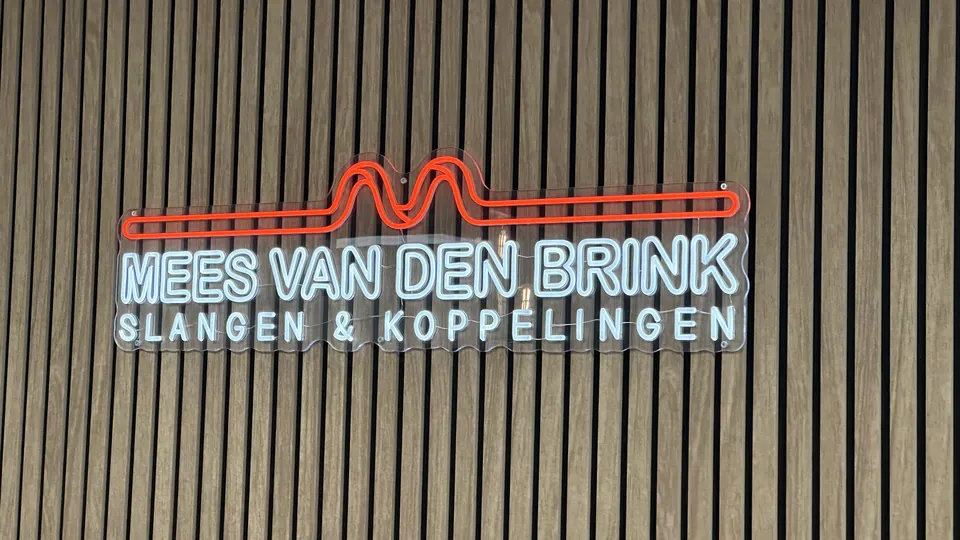
Inside the silicone tube is LED lighting, and the tube spreads that light. That is why you do not see separate LEDs but a continuous line, as with classic neon. With a bare LED strip you look straight into the LEDs, so you often see a row of dots. That is fine for indirect lighting, but for a logo or text you want that even line.
When should you choose LED neon?
- Your name, logo or text has to light up itself. An LED strip does not follow letters; LED neon is bent into the shape of your design.
- The light is the centrepiece. Above a bar, behind a reception desk or on a photo wall, where people look at it.
- You do not want to assemble it yourself. You get a complete sign, and hanging it takes about ten minutes.
- Your logo has details. Fine parts go on the backing as a UV print; see LED sign with UV print.
- You want to dim it or change colour. Every sign comes with a dimmer and remote control, and RGB is possible too.
When does an LED strip make more sense?
- You want to light a room, cabinet, staircase or ceiling indirectly.
- The light should disappear behind or under something, so you only see the glow.
- You want long, straight lines of light along a wall.
We do not sell LED strips.
Can you make a sign yourself with neon flex from a DIY store?
Shops also sell loose neon flex on a roll: a flexible strip that looks like a neon line. It is meant for lines along a cabinet, ceiling or edge. Making letters or a logo with it takes a lot of handwork: you have to shape and fix every curve yourself, and the strip has to be mounted on something.
With a custom LED neon sign that work has already been done. The tube is bent into the shape of your design and fixed to acrylic backing. You hang it up and plug it in. For a text you see the price straight away in the configurator.
What does it look like when it is off?
An LED strip is usually concealed, so you see little of it when it is off. An LED sign, on the other hand, hangs in plain sight. When it is off you see the tube and the backing: a coloured tube keeps its colour, a white tube looks white, and clear backing almost disappears against the wall. If your sign hangs mainly in daylight, choose the tube colour deliberately. See LED neon colours and choosing the backing.

Combining: strip and sign together
An LED strip and an LED sign work well together. Use the strip for mood lighting in the room, along the ceiling or under a bar for example, and the sign as the eye-catcher with your name or logo. Do bear in mind that bright light right next to the sign makes the line stand out less. With the dimmer you match the sign to the light around it.
Examples by room
| Room | LED strip for | LED neon sign for | Read more |
|---|---|---|---|
| Living room | Indirect light behind the TV or along the ceiling | A text or name above the sofa | Living room |
| Bedroom | Soft light under the bed or behind the headboard | A name or word as mood lighting | Bedroom |
| Gaming room | Light behind the desk or monitor | Your gamertag or logo in shot | Gaming room |
| Bar or hospitality | Light under the bar or in the bottle cabinet | The logo above the taps | Hospitality |
| Office and reception | Light in a ceiling or alcove | Your logo behind the reception desk | Office |
What comes with an LED neon sign?
A NeonFlowz LED neon sign comes complete: the sign on its backing, a dimmer with remote control, a power adapter with an EU plug and a 2-metre cable, and a mounting kit. You hang it on the wall with stand-offs or on hanging wires; see hanging an LED sign. How to sort out the power and cable is explained on power and control.
Which one? Four questions
- Does a name, logo or text need to be readable? Then LED neon.
- Do you only want to light a room or an edge? Then an LED strip.
- Do you want it complete and ready to hang? Then an LED neon sign.
- Should the light itself be the centrepiece, also in photos? Then LED neon.
And what about classic neon and lightboxes?
Classic neon is made of glass tubes with gas, on high voltage. A lightbox is an illuminated box with a printed face. Both are different from LED neon. The differences are explained on LED neon or glass neon and LED sign, lightbox or fascia letters. What LED neon is exactly is explained on what is LED neon.
What does an LED neon sign cost?
An LED sign of a logo costs on average between €450 and €850 excl. VAT, depending on the size, the amount of LED tube and the options. A text is priced straight away in the configurator. Dimmer, remote control, power adapter and mounting kit are included. Read more on what an LED sign costs and in the buying guide.